Electrical
Connection access, grounding and customer-defined insulation requirements.
 Request a Quote
Electrification housings
Sealed, thermally managed aluminum housings for battery electronics and power conversion — developed around cooling, isolation, leak control and service access.
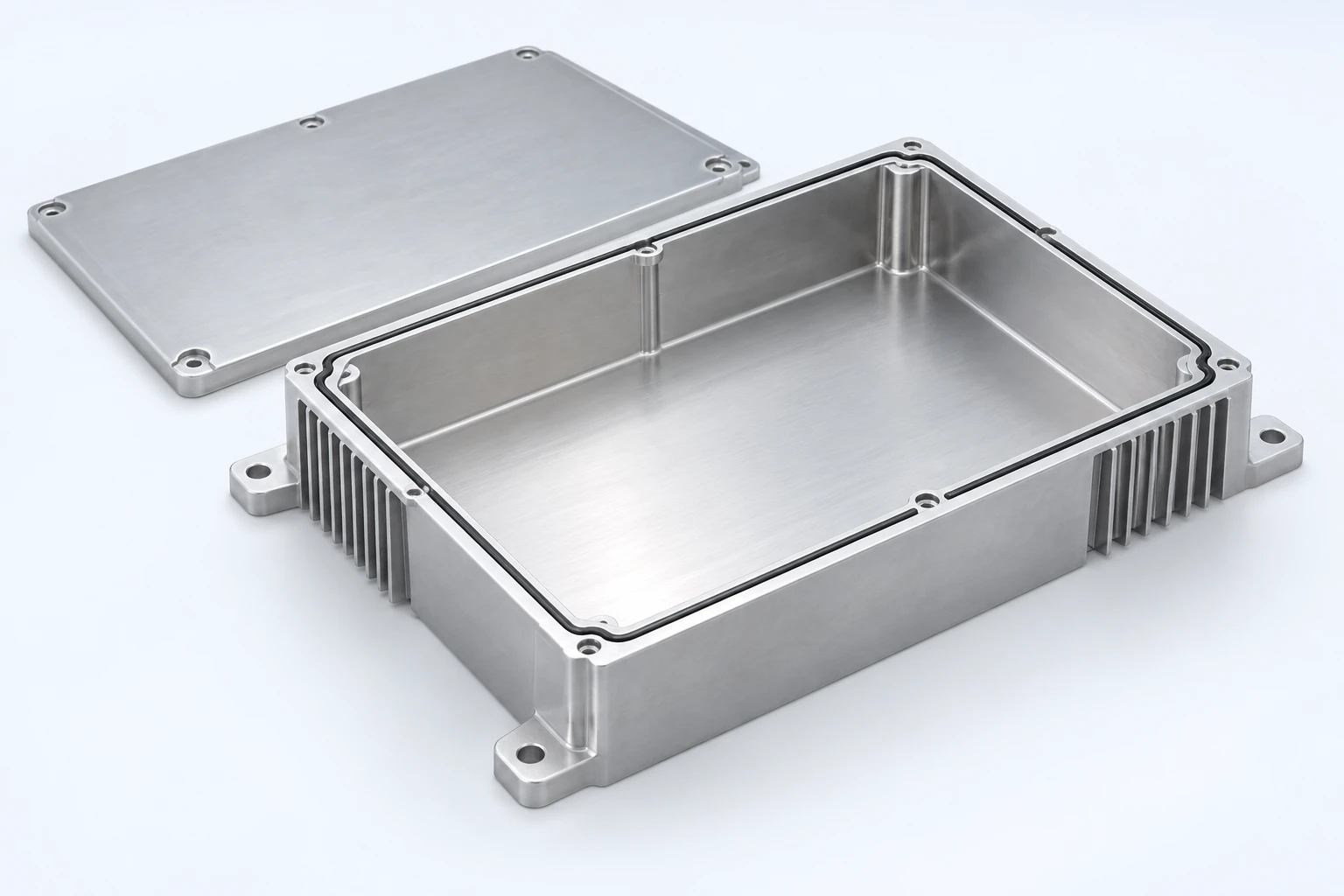
Define the supplied condition, critical dimensions and acceptance plan in the drawing review. Published process references depend on material, geometry and the agreed order scope.
Connection access, grounding and customer-defined insulation requirements.
Cooling interfaces, material contact and machining around heat-transfer surfaces.
Gasket paths, fluid connections, service access and agreed leak-test criteria.
This page concerns component housings and interfaces, not a complete battery pack or its safety approval.
Feature review
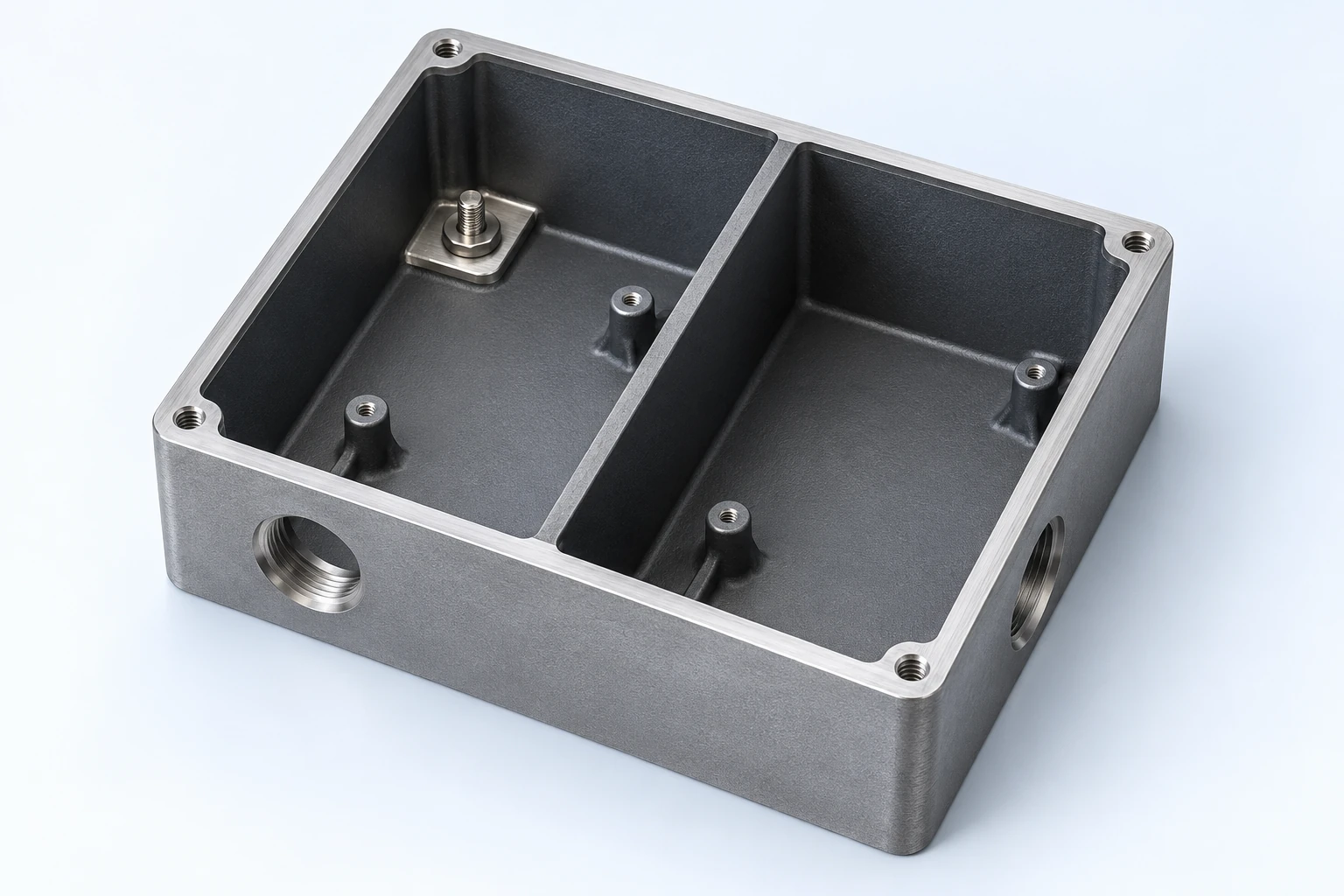
The partition, mounting bosses and side openings divide the enclosure into functional interfaces. Locate the electrical assembly first, then relate its fixing points and connections to the available internal space.
Define contact, grounding and coating-mask areas separately from the gasket land and closure fasteners. Keep the component requirements aligned with the complete assembly review.
Vacuum assistance and overflow design where risk requires
Gasket lands, coolant ports and thermal interfaces
Project-defined air-decay or pressure testing
FAI / PPAP and lot traceability by program
Review compartments, connector openings and fixing points.
Confirm manifold ports, cover lands and thermal contacts.
Agree cleanliness, finished dimensions and sealing criteria.
Review together: joining faces, ports and mounting points; thermal contact and sealing requirements; surface treatment and acceptance plan.
Compartmented junction-box form with port openings.
Tall enclosure form with perimeter flange and side fins.
Long manifold form with ports and cover interface.
Battery and energy-storage housings combine electrical isolation, heat transfer and environmental sealing. The engineering route considers vacuum assistance, machining exposure, gasket geometry, coolant compatibility and the agreed air-decay or pressure-test acceptance limit.
Submit the STEP model, alloy target, finished weight, annual demand, thermal-interface requirements, leak pressure, cleanliness level and PPAP or FAI expectations. These inputs determine tooling, press selection, machining fixtures and validation cost.
Yes. Test medium, pressure, stabilization time and permissible leak rate must be agreed before fixture and cycle planning.
Potentially. Channel geometry, cover joining, corrosion compatibility and pressure validation are reviewed as one system.
Send the part drawing, functional interfaces, operating conditions and production requirements.
Send the model, volume and critical requirements for engineering review and a project-specific quotation.